AI Search Is Looking Beyond Your Website
A client recently asked us why a competitor kept showing up when she asked ChatGPT questions related to her business, but her own business didn’t. Her website was solid. Her copy was clear. So what was AI seeing that she wasn’t?
Here’s the shift we’re seeing: a good website used to be most of the foundation of your online presence. Now it’s one piece of it. AI search engines build a picture of your business from everywhere your name shows up online, not just your website, and they trust that information more when it’s consistent everywhere they look.
Strip away the tools and platforms, and it really comes down to two things: context and consistency. Context means giving AI specific, real details about what you actually do, not vague claims, and providing useful information that directly answers what people are searching for. Consistency means that your business details match everywhere they appear online. As you look at the places below, you’ll see they all come back to the same two things: giving AI clear context and keeping your information consistent.
We think about this the same way we think about every other piece of a client’s marketing: where does it sit on the Vivid Image Marketing Method, and what’s the next best step? Here’s how we’d map the five areas AI is paying attention to our framework, and what we’d tell a client to do first about each one.
Foundation: Google Business Profile
Foundation is about being findable and believable before you spend a dollar on getting more traffic. Google Business Profile lives squarely here, and it’s one that many clients have technically claimed but rarely keep up to date or fully use.
The Signal It Sends & Context It Gives
An active, detailed Google Business Profile tells AI your business is currently operating and exactly what it does, not just that it exists. We’d put this first for almost any client because it’s one of the fastest fixes and an important part of your Foundation that you should already have in place.
What to Try
- Post something short at least once a week: a finished job, a seasonal reminder, anything that shows the business is active
- Go back through your service categories and get specific, since a general category leaves real search terms on the table
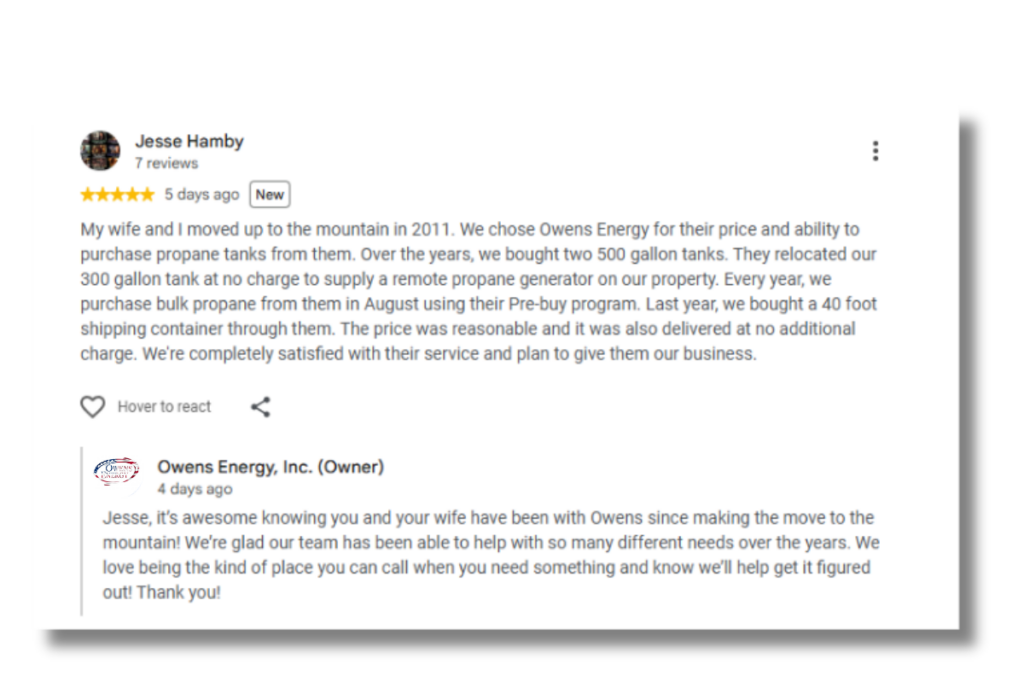
- Respond to every review by name, mentioning the actual service, not just “thanks for the kind words” (See example)
Example of Detailed Review Response
Foundation: Consistency Across Platforms
This is the one that quietly undoes all your other work. If your address, phone number, hours, or the language you use to describe your services don’t match across your website, listings, and social profiles, AI has to work harder to trust any of it. We treat this the same way we treat online listings for any client. It’s part of your Foundation, not an afterthought.
The Signal It Sends & Consistency It Brings
Matching information builds trust. Mismatched information creates doubt, and AI tends to play it safe when it’s unsure.
What to Try
- Search your own business name in Google, ChatGPT, and Perplexity, and see what comes back
- Pick one core description of what you do and use it everywhere
- Fix anything still showing an old address, number, or service area
Active Searchers: Local Reviews & Specific Language
Reviews sit at the intersection of Foundation and Active Searchers, since they build trust and they feed the specific language people search for. The words your customers actually use in a review, and the words you use responding to it, expand what AI associates with your business for people searching right now.
The Signal It Sends & Context It Gives
Real customer language, in their words and yours, teaches AI the specific problems your business solves, beyond whatever you’ve written about yourself.
What to Try
- Ask happy clients for reviews that mention the specific service, not just a star rating
- Respond with language a searcher would actually type, like the service name or the problem solved
Passive Marketing: LinkedIn & YouTube
Passive Marketing is about reaching people who don’t yet know they need you, and it’s also where some of the newest AI search signals live. LinkedIn and YouTube both work the same way here: consistency matters more than perfection. A short video answering one real customer question, filmed on a phone, or a LinkedIn post about an actual job, can do more for AI visibility than a single, professionally produced piece released once a year.
The Signal It Sends & Context It Gives
Regular, specific content on these platforms builds a topic history that AI can reference. A one-time post or video does not build a pattern, but a steady stream of content does.
What to Try
- Post on LinkedIn a few times a month about real work, not announcements
- Fill out your own LinkedIn profile, not just the company page, since AI treats an active owner profile as a credibility signal
- Publish one short video a month answering a question customers actually ask, with a clear, specific title
Loyalty: Earned Media
Loyalty is usually about repeat customers and referrals, but there’s a version of it here too: the relationships you’ve already built, whether with vendors, partners, or past clients, are also your best source of earned media. A vendor case study, a quote in a local news story, or a mention in an industry newsletter all tell AI that other people vouch for you, not just your own website.
The Signal It Sends & Context It Gives
Other people confirming what you say about yourself is the strongest form of proof AI has to work with. One mention from a third party carries more weight than repeating the same claim on your own site.
What to Try
- Ask a vendor or partner if they’d publish a short case study or mention about working with you
- Say yes when a trade publication or local reporter asks for a comment or asks you to write a guest article
- Check local “best of” lists in your area and get submitted where it fits
None of This Requires a Bigger Budget
It requires the same thing the Vivid Image Marketing Method has always required: work the Foundation first, then build from there instead of guessing at what might help. All five of the areas mentioned above come back to the same two things: give AI real, specific context about your business and keep that information consistent everywhere it shows up. If you’re not sure where your business stands with any of this, ask for help. We can walk through it with you and figure out what to focus on first.